Civil ceremony dress vs after-party dress
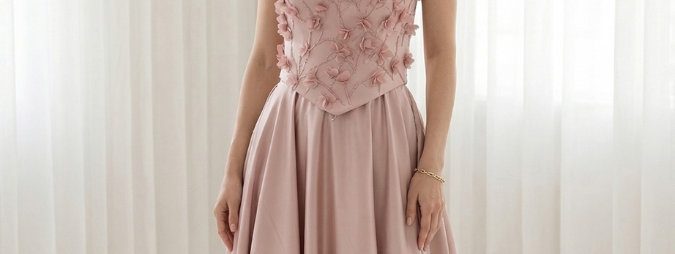
There’s no rule about what a civil ceremony dress or an after-party dress has to look like. A short white dress doesn’t belong only to the ceremony, and a sparkling or colored one doesn’t belong only to the party. The real difference is how you’ll use it: how formal the ceremony is, how long you’ll be in the dress, how much you’ll move, what shoes you’ll wear and whether you can change.
By civil ceremony we mean the official ceremony where the marriage is legally registered. In Turkey it can be short or long, and it may take place in a municipal hall, outdoors, in a hotel or at your wedding venue. The after-party is the celebration with dancing that follows. You can get through both in one outfit, or choose a different look for each. If you’re browsing after-party and civil ceremony dresses, decide by how your day will flow rather than by fashion rules.
What does a civil ceremony dress need to do?
A civil ceremony can be brief or take a while, and the setting can vary. A civil ceremony dress may need:
- A skirt that stays neat when you sit and stand
- A neckline that frames your face and upper body clearly in formal photos
- A design that doesn’t restrict your arms when you sign
- Ease on stairs, in the car and on short walks
- Comfort for a long time, if you’ll keep wearing it through the rest of the day
Midi, mini, long, a suit or a jumpsuit are all worth considering. A civil ceremony dress doesn’t have to be plain; think only about what the setting and the length of the ceremony ask of it. The clean, draped lines people often look for in a ceremony dress also suit modern engagement dresses for engagement and family celebrations, which call for the same elegance and comfort.
What does an after-party dress need to do?
At the after-party, dancing, moving through a crowd and standing for longer take center stage. That makes hem length, weight, arm room and how the dress works with your shoes more important.
A good celebration dress:
- Leaves room for a normal stride and for dancing
- Has embellishment that doesn’t catch on your skin or on people around you
- Has a closure that stays put when you move a lot
- Has a hem length that lets you change shoes
- Comes with a plan for your phone or small personal items
Feathers, sequins, stones, tassels or a big bow can all work, but test them with real movement, not just standing still.
One outfit or two?
Why choose one outfit
One dress removes the change entirely, gives you a consistent look and cuts down on logistics. For that to work, the dress has to give you the presence you want at the ceremony and the freedom to move at the celebration.
A detachable train, overskirt, sleeves, cape or bow can transform a single design. Practice the mechanism so you know it works quickly on the day and doesn’t damage the fabric.
Why choose two outfits
Two outfits let you tailor each part of the day. You can move from a long, formal look to a short, light or colorful party dress. The trade-off is extra budget, plus storage, transport, a place to change and time.
Try on the second dress with the change in mind, not just for how it looks. Undoing the first dress’s closure, taking off the veil, protecting your hair and changing into new shoes can take longer than you planned.
Comparison table
| What to decide | Civil ceremony look | After-party look |
|---|---|---|
| Main movement | Sitting, standing, signing, a short walk | Dancing, turning, moving through a crowd |
| Hem length | Short, midi or long, depending on the venue | Usually freer; a safe stride comes first |
| Train | Can work for the ceremony | Should be bustled, removable or short |
| Shoes | A formal look plus a safe walk | All-evening comfort and grip on the floor |
| Details | A clean neckline and upper body in photos | Embellishment and a closure that are safe when you move |
| Logistics | Getting ready and the flow of the ceremony | A quick change and somewhere to keep your things |
Does it have to be white?
Either dress can be white, colored or contrasting. Pastel for the ceremony and black for the party, or a simple white dress for the ceremony and a bright color for the celebration, are combinations you can build around your own style. The two colors don’t have to be in the same family. If you want comfort and ease of movement through the celebration, a boned, custom-made plus-size evening dress is one option.
If you want your photo album to feel cohesive, carry one detail across both looks: the same earrings, a similar neckline, a repeated floral motif or the same shoe color.
Rehearse the switch between the two looks
Don’t decide on a second dress just because you like two photos. Run through the whole change once, from start to finish, with the person who’ll help you, and see for yourself how long it takes.
| Step | Decide who is responsible | Check at your fitting |
|---|---|---|
| Taking off the first outfit | Who helps with the closure | Removing it without catching your hair or veil |
| Second outfit | Where the dress and underlayer are waiting | Closure, neckline and movement |
| Shoes / accessories | Which pieces change | The hem length with the new shoes |
| Storing / returning | Who collects the first outfit | Clean storage and the way back to the party |
If you’ll stay in one wedding dress, run the same test for the train, overskirt or accessory change. To try a ceremony dress, after-party styles and convertible designs with a detachable skirt side by side, and to experience a quick change yourself, you can book a fitting appointment at our Gaziantep atelier. Living abroad? Our measurement guide shows how to measure yourself, and you can ask us whether a style has a detachable piece before you order. Don’t assume every style has one; check how it attaches and whether it works on the design you choose.
- See the changing space and the lighting at the venue ahead of time.
- Put your own practice time on the calendar rather than trusting a ready-made estimate.
- Don’t leave responsibility for the first outfit until after you’re back at the party.
Frequently asked questions
Can a civil ceremony dress be long?
Yes. A long dress is a valid choice as long as it suits the venue, the space you’ll walk through and your personal style.
Does an after-party dress have to be white?
No. It can be colored, black, metallic or patterned. How you’ll move at the celebration and how safe the dress is to wear matter more than any color rule.
Do I need a second dress?
No. If you can dance comfortably and manage the train in your first dress, one outfit may be enough. A second dress is a choice about use and style, not a necessity. Alongside Glorvia’s special-occasion collection, there are also custom-made evening dresses prepared entirely to your measurements if you’d like a different silhouette for the evening.