How to choose a beach wedding dress

A beach wedding dress doesn’t have to be simply “light and flowy.” Sand, wind, humidity, sun, a boardwalk and how close you are to the water all change how fabric and skirts actually behave. A long veil or train that looks romantic in photos may need constant help in the wind and on soft ground.
The right choice keeps the beach look while letting you walk safely and manage your dress all through the ceremony.
Read the venue by its ground, not its “beach” label
Not every beach wedding takes place directly on sand. Ask your planner or venue:
- Is the ceremony path sand, grass, stone or a wooden platform?
- Is the seating and dining area covered or open?
- How far is it from the bridal suite to the ceremony?
- Are there stairs, ramps or narrow passages?
- Is there an indoor backup for evening humidity and wind?
These details can affect your hem, your shoes and your train more than the name of the silhouette does.
Choose fabric by balancing weight and movement
Very light tulle and chiffon look lively in the wind, but the layers can wrap around your legs or lift more than you expect. Fluttering chiffon also suits a beach, boat or seaside engagement party; see our engagement dresses for that kind of occasion. Fuller satin and mikado hold their shape but can feel heavier in heat and humidity. Lace can snag on sand or on things around you, depending on the motif, the lining and the edge finish.
Don’t judge a fabric just by shaking a sample in your hand. See the dress while you walk in it. Lift the skirt layers and let go: do they fall back into shape or bunch around your feet? If you can, test it in a controlled spot with a natural breeze, such as near an open door.
Judge the silhouette by how you walk in it
Soft A-line
An A-line wedding dress gives you room to move below the waist. On sand, a skirt that skims gently from the waist is easier than a many-layered princess wedding dress. On a beach, what matters is how many layers there are, how much fabric touches the sand and whether you can manage the skirt with one hand. A very full skirt drags more surface across the ground with every step.
Straight or column
Less volume can be easier to manage on the ground, but a slim cut may shorten your stride on sand. Think about how the skirt moves in short steps on soft ground, not only on a hard floor.
Mermaid
A mermaid wedding dress can work on the beach, as long as the point where it flares doesn’t restrict a normal step. Volume below the knee can increase drag on sand. Do a realistic walking test along your ceremony path.
Plan the train for logistics as much as for photos
A long train can look striking on the beach, but sand, humidity and wind make it heavier. If you plan to carry it in your hand all day, the design of your dress won’t really be seen during the ceremony. Consider these options:
- A shorter, narrower train
- A secure loop to gather the train
- A detachable train
- A clean platform along the ceremony path
- A piece added for photos and taken off for the celebration
Try every mechanism at a real fitting. “It gathers up” isn’t enough to go on.
Test your veil and hair accessories in the wind
A long veil fixed at a single point can pull at your head in the wind. Check with your hairstylist that the comb, the pins and the hairstyle can carry the load. A layer over your face can swirl unpredictably during the ceremony, so plan when you’ll use it.
A shorter veil, a fixed cape, a hair accessory or no veil at all are all valid choices. Decide based on the wind and your personal style, not on a rule that “this is what you do at the beach.”
Shoes: think about the sole before the heel
A thin heel can sink into sand. You could consider a block heel, platform, wedge, flats or going barefoot, but take into account surfaces such as wooden walkways, stone and hot sand. Don’t assume you can go barefoot without checking that the surface is safe.
Have your hem set for the real sole height you’ll wear on the day. If you’ll change shoes between the ceremony and the celebration, bring both pairs to your final fitting.
Plan the beach day as a route
A ceremony on the sand doesn’t mean the whole day happens on sand. Write out the bridal suite, the walkway, the ceremony and the celebration area separately, then decide how you’ll manage your skirt and shoes at each transition.
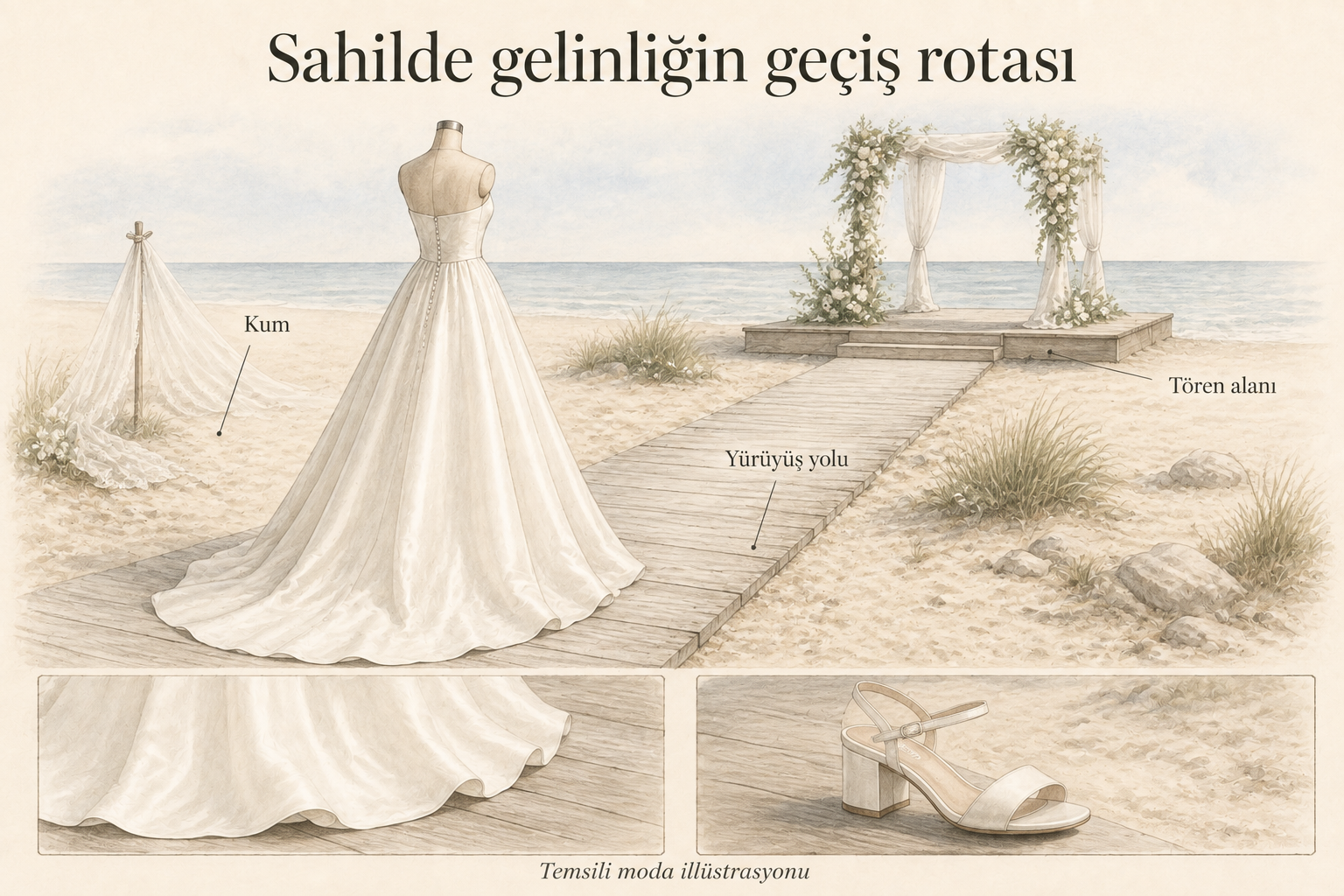
| Part of the day | Detail to decide | Confirm in advance |
|---|---|---|
| Soft sand | Stride, shoes and front hem length | A clear, safe walking route |
| Wooden walkway | How to carry the hem | Gaps and narrow passages |
| Windy ceremony | Veil, open layers and train | Fixings and a backup space |
| Moving to the celebration | Gathering or removing the train | A helper and somewhere to store it |
Don’t test your dress by dragging it across sand or exposing it to strong wind. Look at the venue first, then check how you move in a clean space that the atelier considers suitable. If you can come to Gaziantep, you can book a fitting appointment at our atelier to see how airy tulle, chiffon and crepe styles move and to rehearse a hem length for the beach. Ordering from abroad? Our measurement guide shows how to measure yourself, and you can ask us about hem length, fabric and movement before you order. Don’t assume a train left open for photos will be carried the same way through the ceremony.
- Mark your ceremony route and your photo route separately.
- If you’ll change shoes, see both sole heights at your final fitting.
- Decide who manages the veil in the wind and where your indoor backup is.
Plan your beach look around one style
If you’d like lace and satin together, look at the long lace sleeves and the lace panel inside the slit on Gustosa. If you prefer a plain satin surface and a V-neck, Nova is a different starting point. These are style candidates: judge how comfortable they’ll be on the beach together with the hem length, your real walkway and your shoes. If you like a style, ask us whether fabric swatches are available so you can compare color and texture in your hands.
Frequently asked questions
Can you wear a full skirt at a beach wedding?
Yes. Try the skirt width, hoop, number of layers and how you’ll carry it on the ground, all together. A ceremony path with a platform can make a full skirt easier to manage.
Can you wear a long veil on the beach?
You can, but test the wind, the fixing and the load on your head. If you’ll take it off for the celebration, decide who will do that safely and where.
What should you do if your dress gets sandy?
Don’t apply chemicals or heat to the fabric on your own. Get care instructions in advance. If your dress is a rental, follow the stain and dry-cleaning steps in your rental agreement.