How to choose a dress for a garden or countryside wedding

When people think of a garden or countryside wedding, lace and light skirts often come to mind. But the real deciding factor isn’t the décor, it’s the ground. Grass, soil, gravel, stone paths, wooden platforms and wet surfaces each affect your hem, your train and your shoes differently.
It matters less that your dress “suits the venue” than that it can move with you from the ceremony to the table, from the photo spot to the dance floor.
What to check on a venue visit
The garden you saw in the daytime may be watered, cooler or lit differently at the time of the wedding. Ask your planner:
- What is the ceremony path made of, and what is the dance floor made of?
- Is there an indoor backup if it rains?
- What is the walking surface from the bridal suite to the ceremony?
- Are there gravel patches, gaps in wooden boards or planting edges where your skirt could catch?
- Will the temperature drop in the evening?
- Is it easy to get to the restrooms and a place to rest?
If you can, do this visit in shoes with the heel height you’ll wear on the day.
Think about skirt volume together with the space between tables
An A-line wedding dress offers controlled volume and room to walk. If you’re considering a slim mermaid wedding dress on grass, test the stretch around the knees at your fitting. A princess wedding dress has a wider skirt, which may take more managing between close tables and on grass.
You don’t have to give up a full style. Plan the hoop width, the table layout and the ceremony path together. Measuring the skirt’s diameter and trying sitting down at a fitting tells you more than looking at a photo. If you can come to Gaziantep, you can book a fitting appointment at our atelier to test the skirt shape, light layers and practical train-gathering systems in the mirror. Ordering from abroad? Our measurement guide shows how to measure yourself, and you can ask us about skirt volume, hem and train options before you order.
Check how lace and appliqués react to the ground
Three-dimensional flowers, beaded edges and open-mesh lace can catch on dry grass or thin twigs. That doesn’t make every lace unsuitable; what matters most is how the detail at the hem is made.
Look closely at how the hem is finished and how the appliqués are attached, together with the atelier. If a detail is likely to snag, talk about a different placement or hem length. Don’t test a dress by rubbing it against a surface.
Plan the train separately for the ceremony and the celebration
A long train can look striking at a still ceremony, but it can get dirty faster on garden paths and on the dance floor. Make a three-step plan:
- How the train sits open during the ceremony
- How you’ll carry it when moving to the photo area
- How you’ll gather or remove it for dinner and dancing
Rehearse with the person who’ll help you: where the train loop attaches and whether it takes the weight. Pinning the outer lace at random can cause tears.
Factor the changing weather into your fabric
It may be warm by day and cool at night. For lighter celebrations such as a garden or countryside engagement party, pastel and light tulle engagement dresses let you move comfortably all day. A skirt with many layers can feel heavy in the heat, while a thin, open-back style may feel cool in the evening. You could consider removable sleeves, a cape, a shawl or a top layer, but any extra piece needs to go on and come off without catching on the dress.
Humidity can make some fabrics cling to the skin or make the skirt feel heavier. Check how the lining feels against your skin and how well it breathes while you’re wearing the dress.
Choose shoes and hem length together, for the ground
A thin heel can sink into grass, and open shoes can be uncomfortable on soil and gravel. Consider a block heel, a platform or a flat sole. On slippery ground, make sure the sole is safe.
If you’ll use a backup pair of shoes, compare the heel heights of the two. A lower shoe can let the front hem touch the ground. Do your final fitting with both options.
A small logistics plan for outdoors
- A clean white sheet or cover can protect the skirt in the dressing area.
- You can appoint someone to carry the train.
- You can choose a rain plan and a photo spot ahead of time.
- You can clear the path when you step out of the car.
- You can bring the care instructions, so nobody reaches for a random product if there’s a stain.
Check your hem and shoes against the ground
There isn’t a single “outdoor wedding dress” rule for the different surfaces in a garden. Look at the grass, the stone path and the dance area separately. Often, changing your route or your train plan is enough to keep the same dress.
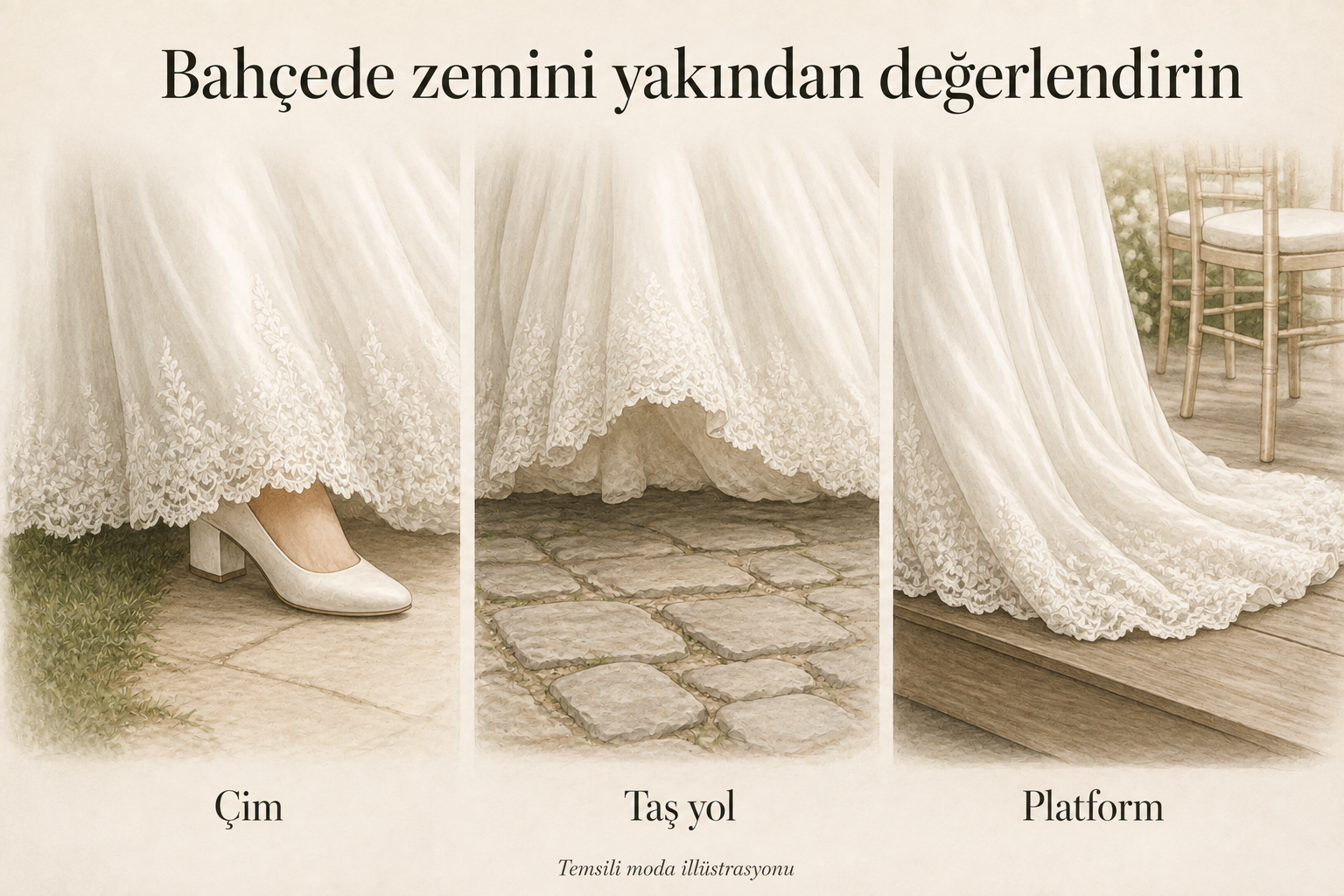
| Surface | Check by eye | Add to your plan |
|---|---|---|
| Grass / soil | Watering, soft patches and mud | A firm path or a clean route for carrying the skirt |
| Stone / gravel | Steps, edges and the lace hem | Transitions where you’ll carry the skirt |
| Wooden platform | Gaps, thresholds and surface condition | Check crossing in your shoes |
| Tables / dance floor | Skirt diameter and chair spacing | Practice sitting and gathering the train |
Don’t test lace or appliqué for durability by rubbing it on a surface. Look at the hem with the atelier; if you need more checking, use a separate sample only if the atelier allows it. A venue visit and a dress fitting have different purposes: one confirms your route, the other confirms how you move in the dress.
- Note every change of surface from the getting-ready room to the dance floor.
- If your backup shoes are lower, check the front hem again.
- Put the move to the indoor space into your rain plan, not just the space itself.
Choose where the lace sits by looking at the style
On Gloire the lace is on the bodice and sleeves; on Gustosa it’s on the sleeves and also on the inner panel of the skirt slit. For your garden wedding, don’t just search for a “lace wedding dress”; choose where you want the lace to be. Then look at the full-length and back views on the product page to see the skirt and train, and add the part you’ll be carrying across the grass to your fitting notes.
Frequently asked questions
Can you wear a princess wedding dress at a countryside wedding?
Yes. Plan the skirt diameter, hoop, table layout and walking path together. A firm, clean ceremony path can help with a wide skirt.
Does a lace skirt catch on grass?
It can, depending on the mesh structure of the lace, the appliqués and how the hem is finished. Look at the hem with the atelier; if you need extra checks, use only a separate sample the atelier allows.
How do you protect your dress if it rains?
Set up an indoor alternative, a clean route, someone to carry the skirt and a plan for the car and the venue ahead of time. Don’t apply protective spray or similar treatments to the fabric without the approval of the maker or atelier.